
The Way New Zealanders Stay is Changing
For a long time, travelling meant choosing between a hotel or a motel.
That is no longer the whole accommodation market.
Short-term residential accommodation has become a meaningful part of how people travel around New Zealand, sitting alongside hotels, motels and other traditional accommodation.
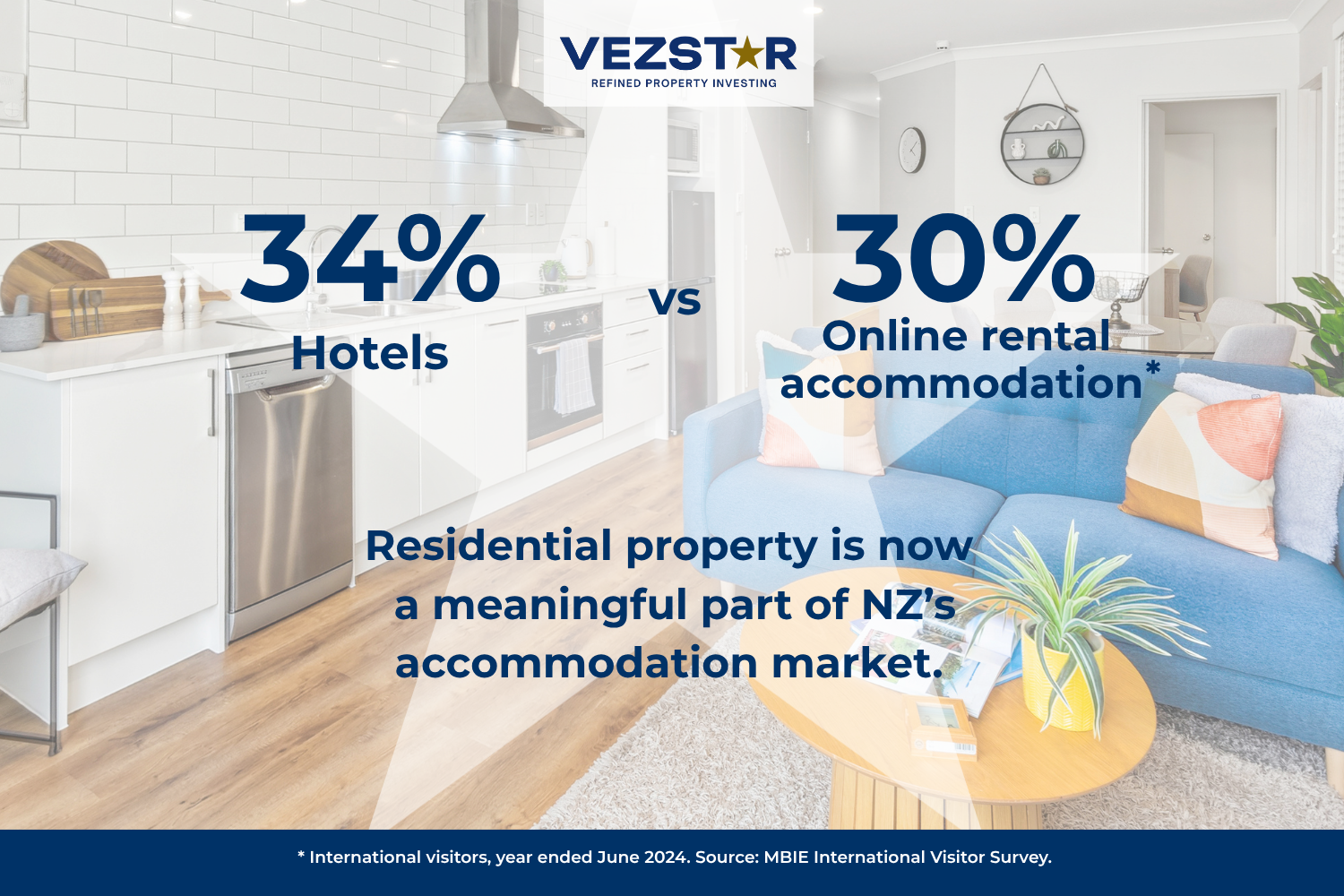
MBIE's International Visitor Survey gives us a useful indication of the change. For the year ending June 2024, 34% of international visitors reported staying in hotels, while 30% used online rental accommodation.
More recent domestic research tells a similar story.
MBIE's October 2025 Domestic Visitor Survey found that 18% of overnight trips involved rented accommodation. Of those trips, 15% involved a house, apartment or room booked online through platforms such as Airbnb, Bookabach, Bachcare or Holiday Houses. Hotels were used on 20% of overnight trips and motels, motor inns or serviced apartments on 15%.
It isn't simply a move away from hotels
This distinction is important.
The evidence doesn't tell us that New Zealanders have suddenly stopped wanting hotels or motels. They haven't.
What it does show is that travellers now have another established accommodation category available to them.
A house or apartment can provide something different from a traditional hotel room: separate living areas, kitchens, laundry facilities, multiple bedrooms and the ability for a group to stay together.
MBIE research prepared around the FIFA Women's World Cup also noted that families can prefer Airbnb-style accommodation because of group size and the cost of requiring multiple hotel rooms.
So rather than thinking about short-term rentals as simply "Airbnbs", I think it makes more sense to view them as part of the wider accommodation industry.
That's where it becomes interesting for property owners
Residential property has traditionally been viewed through a fairly simple lens.
You buy a property. You find a tenant. You collect weekly rent.
Short-term accommodation changes the operating model.
The physical asset may still be a residential apartment or house, but it is being operated as accommodation. That means occupancy, nightly pricing, guest experience, cleaning, maintenance, reviews and distribution across booking platforms all become part of the business.
And that is an important distinction.
Owning the right property isn't enough.
You have to operate it well.
Current market data reinforces just how established this category has become. AirDNA was tracking more than 10,000 active short-term rental listings in Auckland alone as at June 2026, across Airbnb, Vrbo and Booking.com.
What we are seeing at Aspire
This is the part of the market that interests us.
We don't look at short-term accommodation as simply putting a residential property onto Airbnb.
We look at the entire operation.
Where is the property located?
Why would a guest choose to stay there?
How should it be presented and priced?
What is happening with occupancy?
What are guests telling us?
What needs to change operationally?
Those questions matter because a short-term rental is both property and an operating accommodation business.
That also means it carries different risks and responsibilities from a conventional long-term rental. Occupancy can fluctuate, pricing changes, operating costs are higher, regulation matters and good management is essential.
But the growth of online rental accommodation has created another way to think about what residential property can do.
Hotels and motels remain an important part of New Zealand's accommodation market.
They are simply no longer the only game in town.
And for us, that is the interesting part of the story.